
Making Theatre - Movement First.
How I Taught Drama. 8. Creative Drama Teaching.

Most of the time as a drama teacher I was involved in the process of making theatre and whilst we did look at scripted work, the most amount of time we spent was on improvising and devising.
When I started teaching drama most of the focus was on exploring topics, using drama as a tool for understanding the topic being studied. My PGCE furnished me with the following techniques: Still image, conscience alleys, role on the wall, teacher in role, hot seating, role play, mantle of the expert, marking the moment, thought tracking, most of which are techniques that tend to help exploration of a subject more than they develop theatrical understanding and knowledge. We were also taught, emphatically, that there was an important line between Reality and Illusion. This was emphasised by our tutor showing us how to do this: “Right, I am going to go over to the side of the room and when I turn round and come back I will be a different person!” She then proceeded to go to the other side of the room, turn round and come back, without changing and physical or vocal feature at all and ‘pretended’ to be another person by presenting exactly the same person. This, to me, completely confused reality and illusion!
My own theatrical influences at this time, late eighties and early nineties were Berkoff, Theatre de Complicité, Pina Bausch, many other physical theatre companies and, of course, Brecht. This set me on a different trajectory and I was lucky that my head of department, the lovely Vicky Hicks, allowed me to try out different approaches when I started teaching ‘properly’.
When I started teaching out went the topic based approach and in came the focus on the physical. Instead of starting with talking endlessly about ‘homelessness’ or ‘drugs’ and making lots of ‘freeze frames’ we started with movement. ‘Movement first’ became the mantra. Most ‘improvised’ lessons from this point would begin with ‘centring’ and then movement. We were playing in the abstract. We didn’t know what we were doing beyond making movement happen in time and space. By the end of each lesson we would have something recognisably theatrical and moments of real interest and quality. These moments we would ‘frame’ with students noting what worked in their working notebooks. These, pace Brecht, were known as ‘framed moments’.
I’ll detail a typical lesson below and how the mantra was expanded over time to include a whole method of making theatre, which resulted in a wide range of styles and genres, themes and ideas, that was physically and visually very vibrant and intellectually captivating with some wonderful characters, situations and great stories.
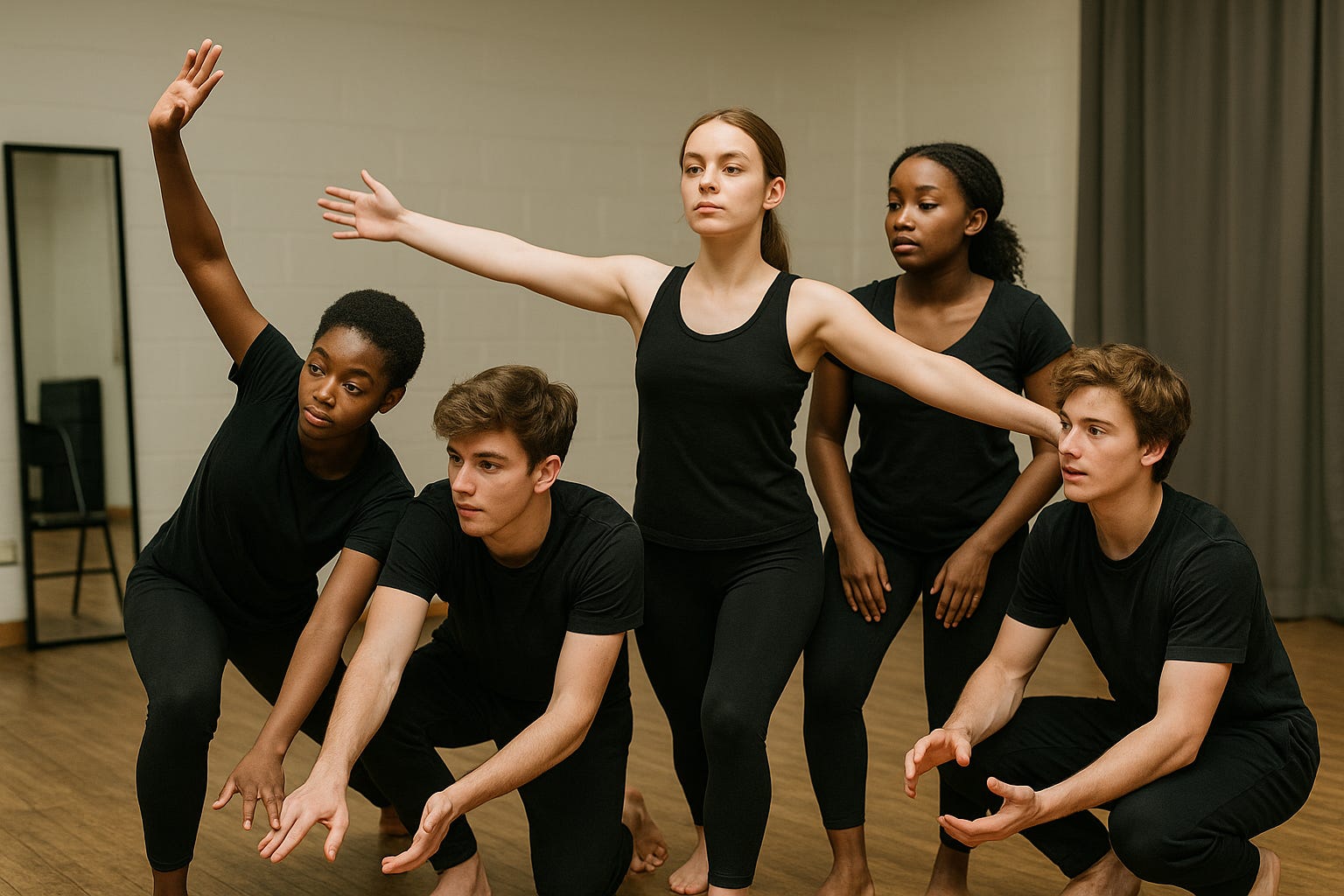
I suppose what I was trying to do was find a way to get kids to make accessible, avant-garde, high risk, highly effective, a mix between modern and traditional, highly impactful, very exciting, very varied, very wonderful, well made theatre.
Whilst at the same time they had to get good grades.
And they did.
How?
By enjoying the contradictions, the clashes and conflicts.
The following way into physical improvisation became the key to unlock the work:
Keep reading with a 7-day free trial
Subscribe to Liberal Arts, Education and Culture to keep reading this post and get 7 days of free access to the full post archives.